Kids Gadget Privacy: 2026 Parent’s Complete Data Guide
Advertisement
Protecting your children’s personal information has become increasingly complex as gadgets evolve. This guide examines the data privacy landscape for kids’ devices in 2026, offering parents actionable strategies to safeguard sensitive information. You’ll discover which gadgets pose the greatest risks, essential privacy settings to configure, and how to establish healthy digital boundaries that grow with your family.
Understanding data privacy in kids’ gadgets: A 2026 guide for parents
The average American child receives their first smartphone or tablet around age 10, and many younger children now regularly interact with smart toys, watches, and connected devices. What many parents don’t realize is that these gadgets often collect, store, and sometimes share remarkable amounts of personal data. From location tracking to voice recordings, from browsing habits to biometric information, the information footprint left by children’s devices can be extensive and, in some cases, surprising.
Understanding kids gadget privacy isn’t just about blocking certain apps or setting time limits. It requires a comprehensive approach that examines what data these devices collect, where that information goes, and what controls parents actually have. The good news is that 2026 brings improved regulatory frameworks, better built-in privacy tools, and increased awareness across the industry. The challenge lies in navigating this landscape while keeping pace with rapidly evolving technology and increasingly sophisticated data collection practices.
What data do children’s gadgets actually collect
Modern children’s devices gather far more information than most parents anticipate. Beyond basic contact lists and photos, many gadgets now collect voice data, location history, browsing patterns, app usage statistics, and even biometric measurements. Smartwatches designed for kids frequently include continuous location tracking, while educational tablets often store voice recordings of children interacting with learning applications.
Understanding the scope of this collection starts with recognizing that most devices operate on a data-driven business model. Even devices marketed specifically for children may generate revenue through data monetization, either directly or through partnerships with advertisers, analytics companies, and app developers. The Federal Trade Commission has increased scrutiny on children’s data practices, but the responsibility ultimately falls on parents to understand what they’re agreeing to when they set up a new device.
Advertisement
Common types of collected data
The categories of information gathered by children’s gadgets typically include several key areas. Location data stands as one of the most sensitive, with many devices maintaining continuous or frequent location records that can reveal daily routines, school schedules, and home addresses. Voice and audio data represents another significant category, particularly for devices with voice assistants or interactive features that may store recordings for quality assurance or algorithm training purposes.
- Precise geographic location through GPS, Wi-Fi triangulation, or cell tower pings
- Voice recordings and audio samples from interactive features
- Photos and videos taken on camera-equipped devices
- Contact lists and communication records
- Browsing history and search queries within apps
- App usage patterns and interaction timestamps
- Biometric data including heart rate, sleep patterns, and in some cases facial recognition
- Device identifiers and technical specifications
Where this data potentially goes
The destination of collected data varies significantly between devices and manufacturers. Some companies maintain robust security practices and limit data sharing, while others may share information with numerous third-party partners for advertising, analytics, or product improvement purposes. Understanding these data flows helps parents make informed decisions about which devices enter their homes.
Essential privacy settings for common devices
Every device category requires specific attention to privacy configuration. Taking time to properly set up these controls during initial device setup saves considerable effort compared to retrofitting security measures later. The following sections cover the primary device types children commonly use and the most important privacy adjustments for each.
Advertisement
Smartphones and tablets represent the most data-intensive category, collecting information across nearly every function. Both iOS and Android platforms offer robust parental control features, but these must be actively configured. Parents should begin by creating a child-appropriate Apple ID or Google account that places appropriate restrictions in place automatically rather than attempting to restrict an adult account.
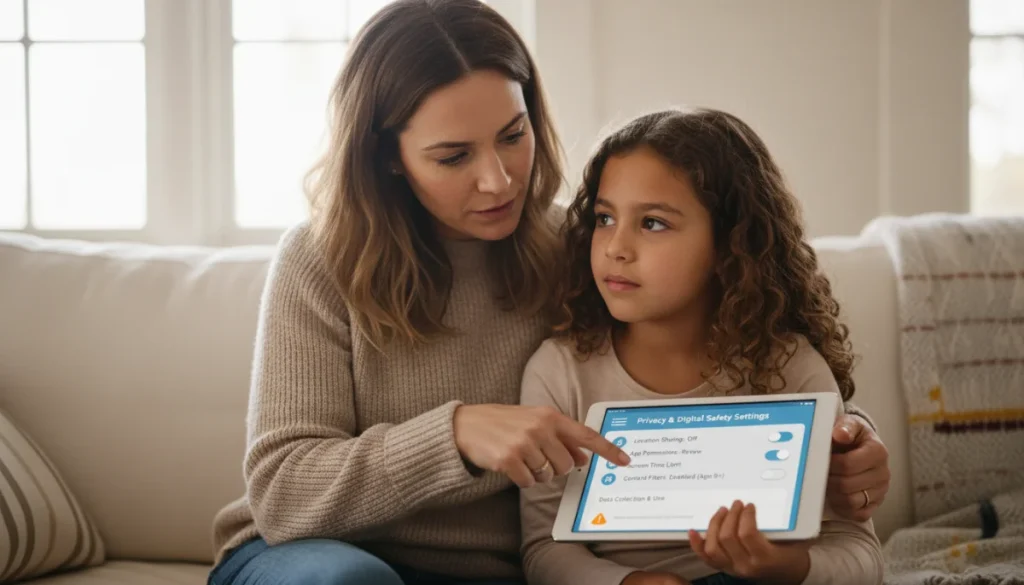
For iOS devices, Screen Time settings provide comprehensive control over app usage, content restrictions, and privacy settings. The key areas to configure include location sharing (set to “While Using” or disabled entirely), advertising tracking (set to limit ad tracking), and app privacy permissions reviewed individually. Android users should explore Family Link, which provides similar controls while allowing parents to approve apps before download and monitor usage patterns.
Smartwatches and fitness trackers
Children’s smartwatches, particularly those focused on safety and communication, often include continuous location sharing as a core feature. While this serves legitimate safety purposes, parents must understand that location data typically accumulates on manufacturer servers. Review the privacy policy to understand data retention practices and whether location history persists after device disconnection.
Disable any features that share location publicly or with non-approved contacts. Some devices allow creating a “safety circle” of approved contacts while preventing broader sharing. Additionally, examine whether the device collects health metrics beyond basic step counting, as some advanced models track sleep patterns, heart rate variability, or other biometric data that warrants additional protection.
Smart toys and connected devices
The category of internet-connected toys has expanded significantly, including everything from interactive dolls to coding robots with app connectivity. These devices often collect voice interactions and may store recordings on cloud servers. Before purchasing any connected toy, research whether the manufacturer has experienced data breaches or has concerning privacy practices documented in reviews or news reports.
When setting up these devices, create accounts with minimal personal information. Use a dedicated email address for device registration rather than a primary personal or family email. Regularly check manufacturer apps for firmware updates that may change privacy settings or data collection practices, as these updates occasionally modify default configurations.
Understanding app permissions and data sharing
Applications represent the primary data collection mechanism on most devices. Understanding which permissions apps request and why helps parents make appropriate decisions about installation and ongoing use. Many apps request access far beyond what their functionality requires, a practice sometimes called permission overreach.
Review all permissions before allowing app installation. Camera and microphone access warrant particular scrutiny, as these can enable extensive monitoring of children’s environments. Contact list access allows apps to build social graphs that may be shared with advertisers. Location access, especially continuous background location, creates detailed records of daily movements. Ask whether each permission makes sense for the app’s core function—a calculator app has no legitimate reason to access your camera or location.
Many educational apps marketed to children have been found to collect and share data beyond reasonable expectations. The Children’s Online Privacy Protection Act establishes requirements for apps targeting children under 13, but enforcement challenges mean parents cannot rely solely on regulatory protection. Examine each app’s privacy policy, recognizing that these documents often use complex language to obscure actual data practices.
Building a family digital privacy framework
Effective kids gadget privacy requires more than technical configurations—it demands establishing clear family expectations and ongoing conversations about digital safety. Creating a written family media agreement helps establish mutual understanding and provides a foundation for discussions as children grow and their digital lives become more complex.
Age-appropriate conversations about privacy should begin early and continue throughout childhood. Young children can understand basic concepts like keeping certain information private and asking permission before sharing photos. Preteens can engage with more sophisticated discussions about how data collection works and why certain protections exist. Teenagers should participate in establishing their own privacy boundaries while understanding the risks associated with oversharing.
Regular family discussions about digital experiences create opportunities to address emerging concerns before they become problems. Ask children about the apps they use, the people they interact with online, and whether they encounter anything that makes them uncomfortable. These conversations build trust while providing parents with visibility into their children’s digital activities.
Practical household rules that support privacy
Establishing consistent rules across all family devices creates clear expectations and reduces the complexity of enforcement. Consider implementing requirements such as charging devices in common areas overnight rather than bedrooms, which prevents late-night usage while reducing opportunities for unsupervised activity. Require that new app downloads receive parental approval before installation, giving parents opportunity to review privacy implications.
- Devices charge overnight in common areas outside bedrooms
- All new app downloads require parental approval
- Privacy settings are reviewed together quarterly
- Social media accounts have parent access until age-appropriate milestones
- Location sharing remains enabled only for family-approved applications
- Voice recordings and photos on shared devices are acceptable family content
These rules should evolve as children demonstrate responsibility and maturity. Gradually expanding privileges while maintaining open communication helps children develop healthy digital habits that will serve them throughout their lives.
Monitoring tools and parental control solutions
Various monitoring and control solutions help parents maintain awareness of children’s device activity without resorting to invasive surveillance. Built-in platform tools from Apple and Google provide solid foundations, offering screen time tracking, content filtering, and usage reports that give parents insight into how children spend time on their devices.
Third-party solutions offer additional capabilities for families requiring more robust monitoring. These range from router-level solutions that filter content across all devices to specialized apps that provide more detailed activity tracking. When evaluating these tools, consider whether the additional capabilities justify the complexity and cost, and ensure any solution respects children’s developing privacy as they mature.
Transparency about monitoring tends to produce better outcomes than secret surveillance. Children who understand why certain protections exist are more likely to accept reasonable boundaries and develop internal motivation for safe behavior. Frame monitoring as a safety measure rather than a trust issue, emphasizing that these tools exist to help the whole family navigate the digital world safely.
Responding to privacy incidents and data breaches
Despite best efforts, privacy incidents may occur. Understanding how to respond effectively minimizes potential harm and provides learning opportunities for the family. Data breaches affecting children’s information have become increasingly common, and parents should know the appropriate steps to take when personal information may have been compromised.
If a device or service experiences a breach, immediately change passwords for any associated accounts and enable two-factor authentication where available. Monitor financial accounts for suspicious activity, as children’s clean credit histories make them attractive targets for identity theft. Consider placing a fraud alert or credit freeze with the major credit bureaus, as children are unlikely to have established credit that would otherwise flag suspicious accounts.
Use incidents as teaching moments rather than simply restricting access further. Discuss what happened, why it matters, and how similar situations might be prevented in the future. Children who understand the real consequences of privacy violations become more invested in protecting their own information.
Looking ahead: The future of children’s digital privacy
The landscape of kids gadget privacy continues evolving rapidly. Emerging technologies including more sophisticated artificial intelligence, extended reality devices, and increasingly connected environments will create new privacy considerations that current frameworks may not adequately address. Parents should stay informed about these developments while advocating for stronger protections at regulatory and industry levels.
Industry trends suggest improving privacy controls, with major technology companies expanding parental control features in response to regulatory pressure and consumer demand. However, the fundamental tension between free or inexpensive services and data collection means parents must remain vigilant. The most effective protection combines technical measures with ongoing education and open family communication about digital responsibilities.
As children grow into teenagers and eventually adulthood, the goal shifts from protection toward teaching self-advocacy skills. Young people need to understand their privacy rights, how to read privacy policies critically, and how to make informed decisions about their digital footprints. These skills become increasingly valuable as their online and offline lives become more intertwined.
| Privacy Area | Key Action Items |
|---|---|
| Device Setup | Create child accounts with appropriate restrictions, configure privacy settings before first use, disable unnecessary data collection features |
| App Permissions | Review all requested permissions before installation, deny unnecessary access, regularly audit installed apps and their permissions |
| Location Tracking | Limit location sharing to necessary apps only, review which applications have location access, consider disabling precise location where sufficient |
| Family Communication | Establish clear household rules, conduct regular privacy check-ins, use incidents as teaching opportunities, maintain ongoing dialogue about digital experiences |
What comes next
Protecting kids gadget privacy requires ongoing attention rather than one-time configuration. As children grow and technology evolves, families must adapt their approaches while maintaining consistent values around digital safety. The investment parents make in understanding these issues and establishing healthy habits pays dividends throughout children’s digital lives.
Start with the steps that feel most manageable for your family, whether that means reviewing current device settings, having initial conversations about privacy, or researching options before purchasing new gadgets. Small consistent actions create meaningful protection, and children who grow up with thoughtful digital boundaries develop into adults who navigate technology safely and confidently.