Smart Lighting Energy Savings: Top Systems for 2026
Advertisement
Smart lighting savings: How modern systems cut energy bills
The average American household spends about $2,000 annually on electricity, and lighting accounts for roughly 12% of that cost. Smart lighting technology has matured beyond simple voice control, evolving into sophisticated energy management tools that deliver measurable savings. In 2026, the market offers solutions that don’t just add convenience—they actively reduce your monthly bills.
Understanding how smart lighting savings work requires examining the technology behind these systems. From intelligent scheduling to occupancy-based controls, modern smart bulbs and fixtures respond to your lifestyle in ways traditional lighting never could. The result is a home that lights itself efficiently, without wasting energy on empty rooms or unnecessary usage.
This guide examines the most effective smart lighting systems for cutting energy costs, helping you make an informed decision about which solutions fit your home and budget.
Understanding smart lighting technology
At its core, smart lighting savings comes from replacing inefficient incandescent bulbs with LED technology and adding intelligent controls that optimize when and how that lighting operates. Traditional incandescent bulbs convert only about 10% of energy into light—the rest becomes heat. LED smart bulbs, by contrast, use at least 75% less energy and last 25 times longer.
But the real savings come from the smart controls. These systems learn your patterns, adjust automatically to daylight availability, and can even respond to occupancy sensors that turn lights off when rooms are empty. The combination of LED efficiency and intelligent automation creates savings that compound over time.
Advertisement
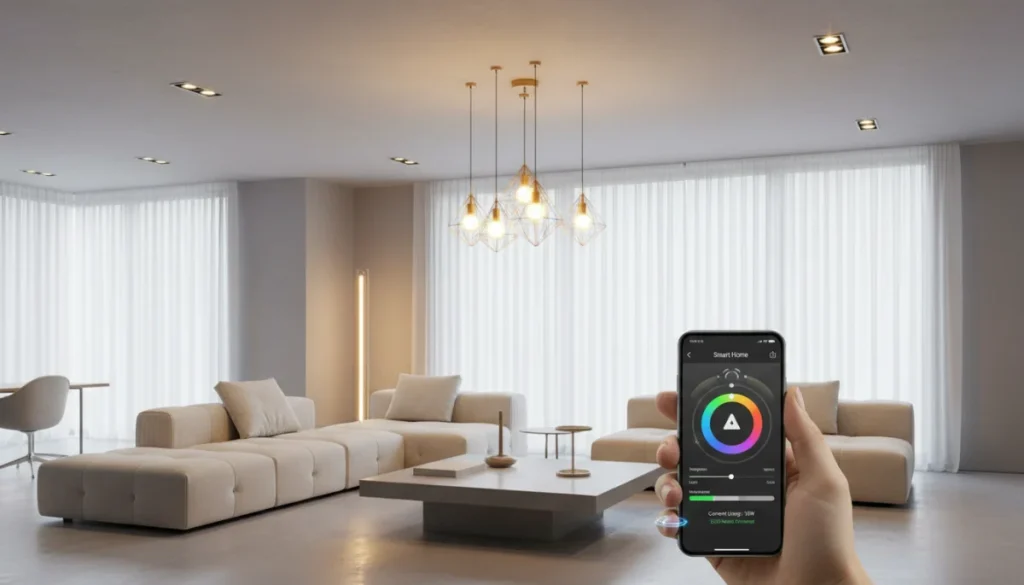
Most smart lighting systems connect through your home’s WiFi network, allowing control via smartphone apps, voice assistants, or centralized home automation platforms. This connectivity enables features like vacation mode that simulates occupancy, geographic-based automation that lights your path when you arrive home after dark, and detailed energy usage tracking that helps you understand exactly where your electricity goes.
Key features that drive energy reduction
Not all smart lighting systems deliver equal savings. Understanding which features actually impact your energy bills helps you choose wisely among the many options available.
Occupancy sensing technology
Occupancy sensors detect when people enter or leave a room, automatically turning lights on or off accordingly. This technology alone can reduce lighting energy waste by 30-50% in frequently used spaces like bathrooms, kitchens, and hallways. Modern systems use passive infrared (PIR) sensors, ultrasonic detection, or even camera-based AI recognition to determine room occupancy accurately.
Advertisement
Daylight harvesting capabilities
Smart lighting systems with daylight sensors measure ambient light levels and automatically dim or turn off artificial lights when natural light is sufficient. This feature proves particularly valuable in rooms with windows or skylights, where lighting needs vary significantly throughout the day. Advanced systems adjust smoothly, creating imperceptible transitions that maintain comfortable illumination while maximizing savings.
Scheduling and automation
Programmable schedules ensure lights operate only when needed. Morning routines might trigger bathroom and kitchen lighting at specific times, while evening schedules create warm, relaxing ambiances. The key advantage is eliminating forgotten lights—a simple oversight that can cost $10-20 monthly in wasted electricity. Smart systems can even adjust automatically for seasonal changes in daylight hours, removing the need for manual schedule adjustments.
- Occupancy sensors reduce waste by automatically turning off lights in empty rooms
- Daylight harvesting dims artificial lighting when natural light is adequate
- Scheduled automation eliminates forgotten lights and optimizes usage patterns
- Energy monitoring provides insights into actual consumption and savings
Top smart lighting systems for maximum savings
Several manufacturers have developed comprehensive smart lighting solutions specifically designed to maximize energy efficiency while maintaining excellent functionality. Each system offers distinct advantages depending on your home’s existing infrastructure and your specific needs.
The Philips Hue ecosystem remains the most widely compatible option, working with Apple HomeKit, Google Home, Amazon Alexa, and numerous other platforms. Its extensive range of bulbs, strips, and fixtures allows whole-home coverage, while the Hue Bridge enables sophisticated automation routines. Recent firmware updates have improved energy reporting features, giving users detailed insights into their lighting consumption.
Lutron’s Caseta and RadioRA systems offer professional-grade performance with excellent reliability. While the initial investment exceeds consumer-grade alternatives, the precise dimming capabilities and robust automation features often deliver superior long-term savings. Lutron’s Clear Connect technology operates on a dedicated frequency, avoiding WiFi congestion that can plague other systems.
For those seeking the most budget-friendly entry point, the TP-Link Kasa Smart lineup provides solid functionality at accessible prices. While the ecosystem isn’t as extensive as premium options, Kasa bulbs and switches offer reliable scheduling, voice control compatibility, and energy monitoring at a fraction of the cost.
Installation considerations and requirements
Installing smart lighting systems ranges from simple bulb replacements to complete rewiring projects, depending on your chosen technology and existing infrastructure. Understanding these requirements helps you plan appropriately and avoid unexpected costs.
Smart bulbs require no electrical work—simply replace existing bulbs with compatible smart versions. This makes them ideal for renters or those seeking minimal commitment. However, smart bulbs work best in fixtures that remain switched on, as cutting power at the switch disables the smart functionality. Smart switches solve this problem but require basic electrical knowledge or professional installation.
Most smart lighting systems require a stable WiFi connection, preferably on a 5GHz network for optimal performance. Mesh WiFi systems have become increasingly popular for smart home installations, as they provide consistent coverage throughout larger homes. Before purchasing, verify that your router can handle additional connected devices—some older routers struggle with the dozens of devices common in comprehensive smart home setups.
Consider also your home’s electrical infrastructure. Older homes with aluminum wiring or non-standard configurations may require professional evaluation before installing smart switches. While smart bulbs work universally, hardwired smart switches must integrate properly with existing wiring to ensure safety and functionality.
Calculating your potential savings
Determining your actual smart lighting savings requires examining your current lighting consumption and projecting the impact of smart controls. The math is straightforward but requires accurate information about your current usage.
Start by calculating your current lighting costs. List all bulbs in your home, noting their wattage and average daily use. A 60-watt incandescent used 4 hours daily consumes 240 watt-hours, or 0.24 kilowatt-hours (kWh) daily. At the national average electricity rate of about 14 cents per kWh, that single bulb costs about $1.01 monthly, or $12.12 annually.
Replacing that bulb with a 9-watt LED smart bulb reduces consumption to 0.036 kWh daily, costing approximately $0.18 monthly. The difference of $0.83 monthly per bulb adds up quickly across an entire home. Adding smart controls that reduce actual usage time by another 30-40% compounds these savings further.
Most households with 20-30 bulbs can expect $150-300 in annual savings from a comprehensive smart lighting installation, depending on local electricity rates and usage patterns. The payback period for the average smart lighting investment typically ranges from 18-36 months, after which savings continue as pure financial benefit.
Maximizing efficiency with system integration
Smart lighting savings reach their full potential when integrated with other smart home systems. Motion sensors, door/window contacts, and environmental monitors can trigger lighting responses that would be impossible to program manually.
Integration with smart thermostats creates powerful automation possibilities. When the thermostat detects everyone has left home, lights can automatically switch to energy-saving modes or turn off entirely. Conversely, welcome home routines can combine lighting with climate control, creating comfortable environments immediately upon arrival.
Security system integration offers both safety and efficiency benefits. Armed-away modes can activate random lighting schedules that simulate occupancy, deterring potential intruders while using minimal energy. Integration with doorbell cameras can trigger pathway lighting when visitors arrive, adding convenience while ensuring lights only operate when needed.
The initial setup complexity increases with system integration, but the combined savings often justify the effort. Many users find that integrated systems deliver 15-20% better savings than standalone smart lighting alone, making the additional configuration worthwhile for budget-conscious homeowners.
| Feature | Energy Savings Impact |
|---|---|
| LED replacement | 75% reduction per bulb vs. incandescent |
| Occupancy sensors | 30-50% reduction in wasted lighting |
| Daylight harvesting | 20-40% reduction during daylight hours |
| Smart scheduling | 10-20% reduction from eliminating forgotten lights |
What comes next for smart lighting technology
The smart lighting landscape continues evolving rapidly, with emerging technologies promising even greater efficiency and smarter automation. Li-Fi, which uses light waves for wireless data transmission, is beginning to appear in commercial applications and may eventually reach consumer markets, offering faster connectivity alongside illumination.
Artificial intelligence integration is making smart lighting systems increasingly intuitive. Rather than requiring manual programming, AI-powered systems learn your habits automatically, anticipating needs before you recognize them yourself. This learning capability leads to progressively better savings as systems understand your household’s patterns.
Grid-responsive lighting represents another frontier, where smart lighting systems can automatically reduce consumption during peak demand periods when called upon by utility companies. Early pilots suggest this capability could earn homeowners additional savings or credits while supporting grid stability.
For now, installing a quality smart lighting system remains one of the most accessible ways to reduce home energy costs. The technology has matured sufficiently for mainstream adoption, pricing has become reasonable, and the savings are well-documented. Whether you start with a few bulbs or commit to a comprehensive whole-home system, smart lighting savings are available to virtually any homeowner willing to make the switch.